Art did not only become my profession because I was trained for it. It became my language because everything else shifted.
What I see in this photograph now is endurance. A creativity born from discipline. Inspiration came later.
Seen now, the photo looks almost disarmingly unposed, far from the logic of a selfie. There is no constructed angle. This is where endurance shows itself without announcing anything, because creativity here is something trained into the body.
If you look closely, you can see that the bare feet have worked. They carry traces of ballet. Pressure marks, plasters. In my hands, an analogue film, and attention to something not yet allowed to exist. In the background, framed, a sketch of Michelangelo’s Dying Slave. The image does not only describe discipline. It shows what years of artistic practice leave behind.

This vintage photograph is a quiet document from the 1990s, with a film container in my hands and a drawing of Michelangelo’s Dying Slave in the background
Some lives seem to move effortlessly in a straight line. Others follow a timeline of their own. Their only constant is movement. For a long time, my memories were not attached to dates. They gathered around people, homes, countries, languages, but also departures. Slowly, transition became a structure. And for a long time, artistic practice was the only place where something like belonging seemed possible.
I was born in 1981 in Novovolynsk, a small town in western Ukraine, which at the time was still firmly anchored in Soviet reality. When I speak of a happy childhood, I do so with care, because this happiness was not a condition that simply existed on its own. It was an achievement. A collective effort, carried by a family that had to create stability again and again. Against challenging conditions, against scarcity, against a reality that kept shifting.
Like ink dropped into a glass of milk, memory begins to cloud at the edges, now that it lies so far back. From a distance, life in Soviet Ukraine can begin to look like a brief, unstable episode. In truth, its roots ran deep through generations, forming the fragile foundation beneath everything.
I remember turning on the taps and watching rust come out instead of water. Large pots stood on the stove, boiling whatever could be collected, kept as a reserve for the next failure. Even this could feel like a sign, as though the infrastructure itself had lost faith in permanence. Something as basic as water was supposed to be the state’s responsibility. And somehow, the guilt and shame of failing infrastructure became something people had to carry.
People learned early to live beneath the surface. To adapt, always and everywhere. What looks like adaptation here wasn't submission. It was the hard-won skill of holding something steady in an unstable world.
Creativity existed, but it had learned to exist far away. In exile, real or only intellectual. And yet this country was never artistically poor. Just think of Malevich. Born in Kyiv, later claimed by different histories, and drawn into the fractures of the century. That he came from Kyiv, where my little cousin still lives today with his fiancée, no longer feels like a biographical footnote. It feels like something the whole region carries. Free will appeared only occasionally, like a distant possibility on the horizon. Even Polish radio was jammed, although the Polish border lay almost within walking distance of our dacha.
And then there was our dacha. I grew up with my granny. My grandpa had died a year before I was born, and yet he was present, in the form of an almost finished dacha he had left behind. Something unfinished that still felt like a promise. My dad completed it later, not because it promised security, but because it held hope. I helped too, as much as I could. I was already 2, after all.
“привет всем дачникам и неудачникам” *
My grandpa scratched this into the wet cement layer. Fossilized for the lifetime of a house, perhaps longer. A few years later, my dad and I pressed our hands beside them. His inscription, my dad’s handprints, my tiny hands: all of it held in the concrete foundation of the house. The logic of the place was already in that foundation. Working together. Leaving traces without knowing who might read them one day. Not founding a house on perfect stability, but on return. Coming back. Repairing. Continuing. Enduring. Adapting.
Just as the dacha was a place of improvisation, so was our home. What stayed was often what people kept returning to. Several generations of us lived in one apartment. My mom was working on her doctoral thesis in Moscow, my dad taught philosophy in Lviv. Between all of us lay absences, bus rides, trains, and distances measured in days.
Keeping things in place was a form of care. Objects had their place because they stayed, because they kept the world from scattering completely. You put them down so you could return to them later. And to reassure yourself that such a later could exist at all.
Before my cousin Tyoma was born, my granny, my uncle, and my auntie looked after me whenever my parents couldn’t. They supported me wherever possible. Ballet lessons from the age of three. Seven years of piano lessons, all wasted, because all I wanted was to draw.
At some point, I found my auntie’s book from the Louvre. In it, Michelangelo's Dying Slave. I have no real story about this. No date, no occasion. Only the fact that I drew him again and again and again. It was a childhood obsession and an early artistic ambition. My auntie’s books from Paris became a doorway before I knew what art history was. The Dying Slave was the first to carry me out of the world as I knew it and into another. He accompanied me for many years because even then he showed me that a body can be graceful and trapped at once.
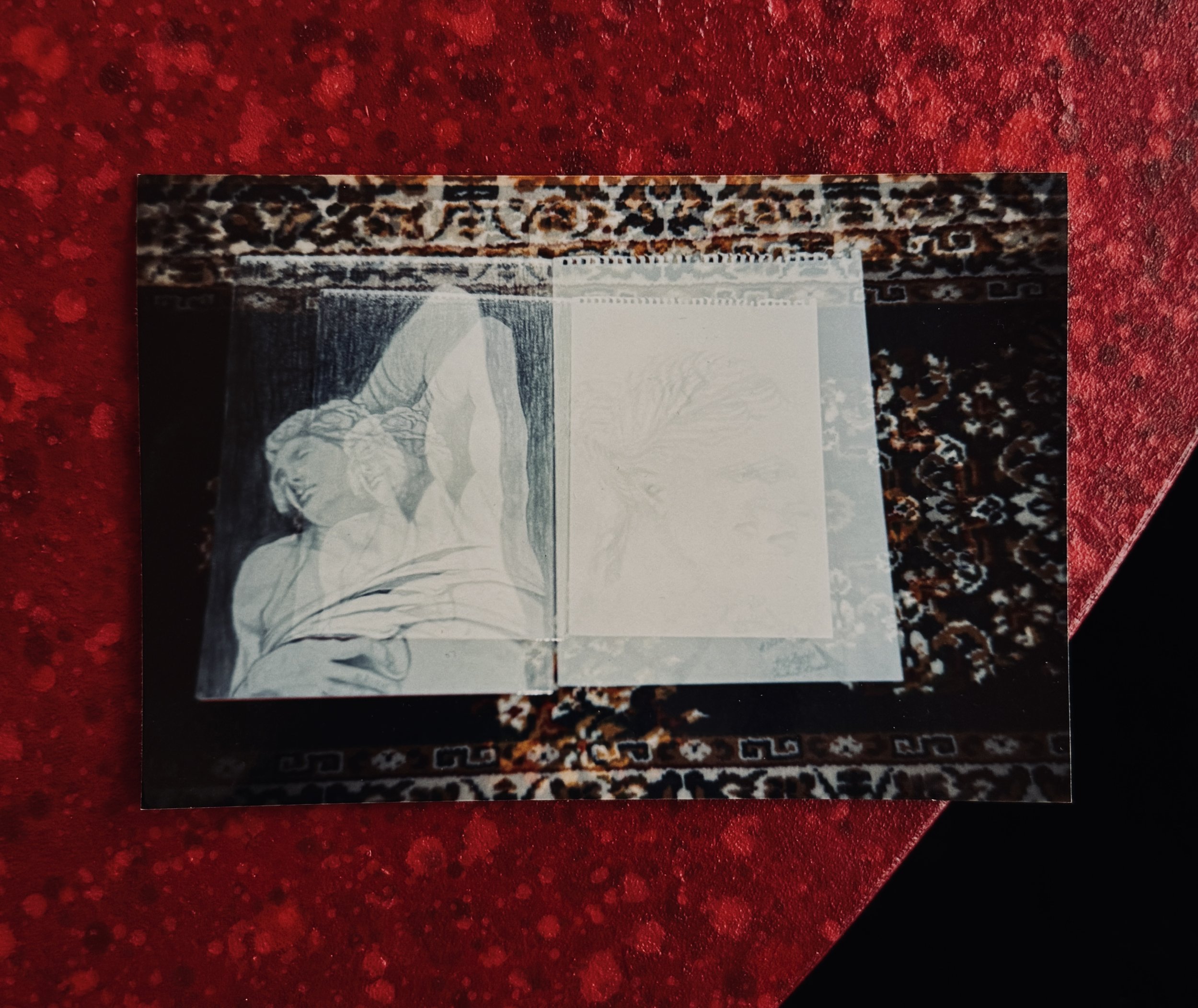
Experimenting with analogue double exposure: early Study After Michelangelo’s Dying Slave
Years later, after several moves and a life spent in different countries with different languages, all these drawings were lost in a flooded basement. Only two photographs remain: one of me as a teenager, sitting in front of the framed sketch. And one analogue photograph showing that I was already experimenting with double exposure at an early age. A strange doubling, an image within an image, a memory of a memory.
Some artworks enter quietly and keep working in the background. At the time, they may not seem important at all. Years passed before I understoods what they had opened. When I changed countries, learned languages, and adapted again. Art remained. It moved with me without asking for translation.
My story does not follow a straight line. It’s made up of shifts. At the age of nine, I moved to Germany, later lived in the United States, and eventually returned to Germany. Between these places lay languages, school systems, cultural codes, and assumptions that had to be reordered each time. Every change of place brought with it another set of rules, another way of locating oneself.
For me, migration meant standing at the edge at first. I listened more than I spoke. I read gestures before I understood words. Art accompanied me through all these systems. It required no translation, no comparison, no explanation. It reached me before language did. While the things that made me feel I belonged kept shifting, art remained understandable, independent of place, language, or context. It was the one language that worked everywhere, even among strangers.
This explains what I could not put into words for so long. I had thought about it for years. I just didn't trust how clear it would sound. There are experiences that tip over the moment they're named. They slide into narratives that are not one’s own. Victim, survivor, exile. Those are all available terms, all well-intentioned, and yet often too coarse for what was actually lived. In the last few years, something started to feel different. As if you were standing in a room you had known for years, only to realize one day that the furniture had moved and you no longer expected the old collisions.
Adaptation had been necessary in my life. Becoming quieter, fitting in, keeping certain parts of myself hidden, but art was the one place where I did not have to translate myself first. The first reaction to my work was rarely intellectual. People felt something before they tried to explain it. An instinctive recognition before understanding. In the Sorbet works, this becomes slower, almost meditative: pigment and water poured over months. Art became a way of paying attention before making a statement.
Those who grow up in transitions learn early that the world can change before you are ready. That stability is not given, but must be created. And that what carries us is often a small gesture, a ritual, an object that remains although everything else shifts. For me, art belongs in this category. Not as an exception or luxury. As part of everyday life, as something that offers support. For me, art remains a way of staying with an experience before trying to explain it. I follow what it sets in motion. A room that remains open. A thought that does not close. A presence that does not want to be explained. I do not need to say what it is. I notice what it does to me. Sometimes that is enough.
* = “привет всем дачникам и неудачникам”
Literally, it could be translated roughly as:
“Hello to all dacha owners and unlucky ones.”
Or: “Greetings to all dacha people and misfortunates.”
But this is precisely where the challenge of translation begins. The Russian works here with rhyme and an internal shift that is almost impossible to reproduce in English:
дачники (dachniki): people with a dacha, a summer house, a place of retreat, something of their own
неудачники (neudachniki): losers, unlucky ones, those for whom things did not work out
The two words differ only by a single prefix: дача, dacha, something one has or possesses, and неудача, failure or misfortune. In Russian, this creates a laconic resonance that says: having a dacha does not make one a winner. And those who fail still belong.
In English, there is no comparable word family in which possession and failure lie so close together. Every translation must choose. And in doing so loses precisely the wit.