We constantly tell ourselves and others who we are. Then life interrupts the story. Sometimes with a plastic bag full of yellowed letters and the discovery that reveal who you were before you became someone.
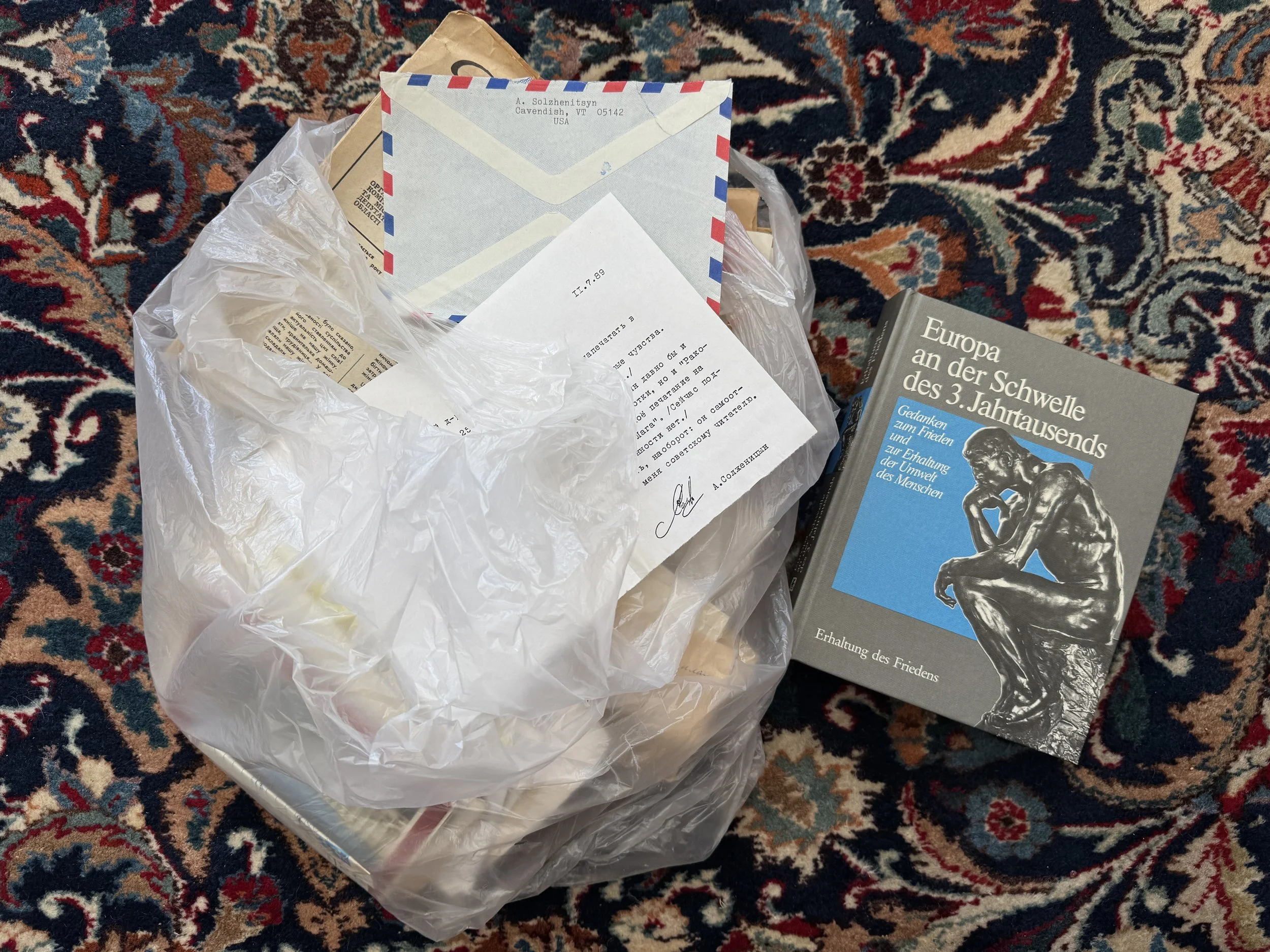
A plastic bag of yellowed letters, written to my stepdad by Alexander Solzhenitsyn, beside Friedhelm’s book on peace and Europe. The beginning of an archive.
I only understood how far my family research actually went when I opened a letter written to my family by a Nobel Prize laureate. I did so with conflicting emotions. There was reverence, but also unease, and the knowledge that history leaves its figures behind in contradiction. I knew, almost immediately, that the letter would not close anything. It would raise more questions. There is still much I have to learn in the coming months, because originally I had only questions about art. Questions that have accompanied me my entire life:
Why is beauty considered a luxury in the West, something you allow yourself only once your basic needs are met? While in the Eastern European societies I grew up in, it was treated as a basic need in itself? From there, further questions emerged. How beautiful is art allowed to be in times of crisis? And must it illustrate geopolitical conflict in order to resolve it, as is so often demanded?
At first, I searched for answers in art. But art does not answer everything. Neither does illustrative documentation or commentary. News often does that. Art begins where time folds in on itself. It makes visible what continues to live inside people long after events themselves have passed. And these tensions are not questions of taste or style. They are forms of cultural conditioning.
These are the questions my family and I have been circling for decades. Do we need more rhetorical force, more confrontation? Or do we need a deeper sensitivity to what language and art awaken in human beings, emotionally, historically, and atmospherically?
Those who grow up transculturally eventually begin to notice that every society expects something different from art, and that every artist carries a different agenda. “The art world” is not a morally unified collective with one shared task. Artists do not function like a political party. Not even within the same historical catastrophe.
Not every ability is made for the same form of resistance. When you zoom out and place it in an East and West European context, you understand why not every cultural response to a threatening present speaks the same language. Of course violence, conflict, and injustice must be made visible. But a language built almost entirely on accusation, confrontation, and alarm does not necessarily create deeper human connection. It can generate attention just as quickly as exhaustion and emotional withdrawal.
I have written before about the reality of my Soviet childhood in Ukraine, and I will continue to. About how sometimes only rust came from the taps instead of water, because even basic infrastructure was shaped by scarcity, control, and improvisation.
In Ukraine, I spent most of my time with my grandmother Ljubow in Novovolynsk, together with my uncle Viktor, my auntie Valentina, and my cousin Tyoma. Later with my daddy Alexander and my golden hamster Tina in Lviv, where he taught philosophy at Ivan Franko University, while my mommy Nina travelled repeatedly to Moscow to study. There she met my future stepdad Friedhelm, a professor of linguistics who lived in Dortmund and taught in Bochum. In 1991 my mommy and I moved to Germany, and I did not simply enter a new family and a new household. I entered an intellectual climate shaped by language, exchange, and the sincere, careful attempt to build bridges between worlds that officially so often stood in opposition to one another.

Eating ice cream with Friedhelm
Friedhelm — "he who protects peace"
from Old High German: /fridu/ - peace, safety, /helm/ - protection, preservation
I am fairly certain I am forgetting a language or two, but Friedhelm spoke flawless Russian, fluent Chinese and English, learned Dutch shortly before his death, and spent decades working on questions of the Soviet Union, language, and cultural understanding.
The house I later moved into had been designed by him in the 1970s, with a small additional room under the roof, its own entrance, bathroom, and a separate electrical circuit. In our family it was simply called “the guest room.” But the name came from a kind of natural openness, because over the decades entire delegations seemed to pass through it. Exchange students, scientists, writers, musicians, guests from all over the world lived there. Today, it is my studio.
Friedhelm did not only teach me German. He built a bridge before I even understood I was standing on one. I arrived in Dortmund in May 1991, and during the summer holidays he sat with me in the garden practicing “der, die, das.” “Der, die, das.” “Der, die, das.” Then grammar. Ugh. Verbs. I hated it, of course. But I owe so much to him. Thankfully, I was able to move directly into fourth grade without visibly failing at the threshold of a new society.
But language forms slowly. And all of us know the feeling: not being able to follow adult conversations as a child. In our home, those conversations always seemed to circle around someone called Bert Brecht. His name appeared constantly at the dinner table, as though he were one of those familiar house guests you never actually see but somehow know intimately.
Much later, when Brecht appeared on the curriculum before graduation exams, I asked my mom whether Friedhelm had actually known Bertolt Brecht. She corrected me, saying that Brecht had instead left a tremendous impression on him after Friedhelm spoke to him once following a theatre performance.
But the person he truly knew, she said, was Max Frisch. They had shared a train compartment on the way to a peace conference in Moscow, to which Gorbachev had invited.
“I should have kept a diary,” my mom said.
…
And ever since, I have carried this image with me: a train to Moscow. A writer. A linguist. Conversations of which nothing survives. Who would not be haunted by such an inherited absence?
I have tried ever since to fill that void through Friedhelm’s publications and through all the fragments he left behind. Most of them revolve around the preservation of peace through language. Just like this book, which Friedhelm co-edited.

Friedhelm’s book on peace and Europe, photographed in sunlight, as an object of memory, thought, and inherited questions.
Naturally, it also quotes Brecht. Brecht of all people, who so often called as the great witness of politically confrontational art. Yet the passage chosen by the book sounds like this:
"… There was also a love. She was twelve, he fifteen years old. In a bullet-scarred courtyard she combed his hair … The love could not endure; a great cold came. How shall the young trees bloom, when so much snow has fallen?"
Not accusation. Not shock. Quiet images as protection against emotional numbness. That, too, is Brecht. That, too, is resistance.
And suddenly my questions about art appeared to me in a different light. Artists today are often expected to make the present visible, to react immediately, to produce moral positioning, to aesthetically process historical events almost in real time. In the process, people often forget that art is made by human beings, not by programs.
The longer I read Friedhelm’s texts, the more I find myself occupied by the idea that peace work itself can never take only one form. That understanding does not emerge exclusively through politics, but equally through language, literature, architecture, memory, and through the ability to keep human beings inwardly open.
Between the texts stood writers alongside politicians, scientists alongside artists, linguists alongside historians. No shared aesthetic. No shared language. Not even the same idea of how one ought to respond to history, or work against the destruction of the world. And suddenly there was something deeply consoling in that.
Some people document. Some warn. Some analyse. Some negotiate. Some translate between worlds. Some simply try to keep the human being capable of feeling.
Max Frisch once wrote: "We asked for workers, and human beings came."
Something similar is true for art.
People often demand from it moral clarity, reaction, categorization, historical positioning. And then human beings arrive. With their fractures. Their contradictions. Their hopes. Their memories. With their different fears. And their different ways of working against the collapse of the world.
P.S. The sister essay on why beauty so often appears as a luxury in the Western context, while in Eastern European lives it is felt much more strongly as a basic need, is already in progress. But as the new findings from the family archive have shown, it needs more time, because many positions have shifted over the past decades and need to be read anew.
Sources and Literature
Europa an der Schwelle des 3. Jahrtausends. Beiträge aus Politik, Wissenschaft und Kultur, edited with the collaboration of F. Denninghaus, R. Friebel, K. Waschik, […], Dortmund/Moscow, 1986.
Bertolt Brecht: Children’s Crusade 1939.
Max Frisch: foreword to Siamo italiani – Die Italiener, 1965.