Collector’s Guide to Displaying and Preserving Artworks at Home
Have you ever heard of the concept of a facsimile?
Neither had I. Despite spending most of my life working in, living with, and making art. This concept was foreign to me, until I worked inside museums and saw how they use facsimiles to allow engagement without exposing originals to harm.
That discovery reshaped my approach to protecting artworks and influenced how I live and work with them. If you’ve followed my practice for some time, you may have observed occasional changes in my living space, this is why. But let’s take it step by step.
In between my high school graduation and my art history studies at university, I worked at several museums. That experience allowed me to learn essential conservation principles directly from international institutions. Many of these lessons can be applied at home and help honor the materials an artist has chosen by giving each work the conditions it truly deserves.
I don’t want to be a Debbie Downer, but this is where things get tricky! Living with original art has become more common, yet the understanding that artworks can’t always be preserved under ideal conditions at home remains limited. This gap often leads to uncertainty. Especially when artists, galleries, or auction houses use terms such as “museum-grade” or “meets museum standards” to market their works.
When a piece is said to be “museum-grade,” it simply means that its materials are capable of lasting for a long time under museum conditions.
But private homes are not museums. Light levels shift throughout the day. Temperature and humidity fluctuate. Sun exposure is rarely consistent. Even the highest-quality materials will only endure as well as their environment allows.
Collectors often ask how they can create the best possible conditions for artworks in a private home. While museums operate with strict conservation standards like controlled light, working with facsimiles, limited display periods, dark storage, stable climate, and archival framing, there are also many practical steps collectors can apply at home.
The most important and damaging factor is light.
WHAT MUSEUMS ACTUALLY DO
Control light precisely
Measure and limit illuminance by material sensitivity. They use indirect light and timed exposure rather than constant bright light.
Eliminate or minimize UV exposure
Use UV-filtering glazing, filtered lamps, and window treatments to reduce ultraviolet radiation.
Rotate displays
Limit the time sensitive objects spend on view and follow scheduled and long (LONG!!!!) rest periods in dark storage.
Provide dark, climate-controlled storage
Keep objects in low-light or no-light conditions between displays, at stable temperatures and relative humidity levels.
Stabilize environment
Monitor and minimize fluctuations in temperature and humidity, and consistent conditions reduce mechanical and chemical stress.
Use archival-grade materials
Mounts, backings, and housings are acid-free, inert, and chosen to avoid off-gassing and physical contact.
Architectural and object-level protection
Vitrines, spacers, microclimate enclosures, and appropriate framing prevent direct contact and environmental shock.
Document and monitor
Condition reports, logs of light exposure, and environmental monitoring form a record and an early-warning system.
Use facsimiles and surrogates when appropriate
To preserve fragile originals, institutions exhibit accurate reproductions so the content remains public while the original rests.
A COLLECTOR’S TRANSLATION: PRACTICAL STEPS YOU CAN USE AT HOME
Rethink your role: you are a co-guardian, not merely an owner
You’re not just buying a piece: You are welcoming it in. The artist starts the journey, and you help it grow.
Light: manage it, don’t worship it
Keep artworks out of direct sunlight! Prefer low-intensity LEDs and dimmable fixtures. Use timed lighting or motion sensors so works receive light only when viewed. For sensitive works like photography or works on paper, aim for very low light levels; for sturdier paintings, moderate, controlled light is acceptable.
Fun story: once, I travelled to Paris to see Odilon Redon at the Musée d’Orsay. I walked straight to the room where his pastels had once stopped me in my tracks, but every piece was gone. The room was closed. The works were resting in long-term storage. A classic facepalm moment, though Paris is always worth the trip, not only to see his pastels ;-) That moment taught me museums rotate and protect what they love most. At home, you can adopt a similar mindset: change locations, give pieces light breaks, or temporarily swap artworks.
Block the worst offender: reduce UV
Use museum-grade glazing or UV-filtering acrylic in frames. If window light is unavoidable, apply UV window film or heavy drapery.
Rotate: give works rest
Adopt short display cycles. Example: show a work for 4–8 weeks, then store it in darkness for several months. Temporarily replace it with another work. Even occasional “rest periods” greatly slow cumulative light damage.
Create micro-habits for a stable microclimate
Avoid hanging art in kitchens, bathrooms, above radiators, open windows, next to ovens, or on exterior walls. Use a digital thermo-hygrometer to monitor the room. Small adjustments like closing a window or moving a frame, make a big difference.
Frame like a conservator
Use acid-free mats and backing, spacers so the artwork doesn’t touch the glazing, and archival tapes. Ask your framer for “museum-grade” framing and specify materials.
Document and check
Take condition photos on acquisition and every 6–12 months. Keep a note about location, exposure, and any changes. Prevention is always better than fixing things afterward.
Consider facsimiles or other works for everyday display
If you want to live closely with an image in bright rooms or high-traffic spaces, commission or request a high-quality facsimile to exhibit, and store the original. Some collectors do that. A facsimile preserves the viewer experience while the original preserves its longevity. This is exactly where it gets tricky. If you bought a piece to enjoy it every day and no facsimiles are offered, try to take precautions. But of course, not everyone wants to live with a facsimile, and that’s not always the point of owning an original artwork. At the same time, you have to accept that if the piece is exposed to a lot of sunlight, no museum-grade glass or materials can fully protect it from light damage, because sunlight is the greatest factor in deterioration. Keep in mind that artworks preserved in museums for hundreds of years exist under completely different conditions. Even if an artist guarantees museum-grade materials, it’s ultimately the environment that determines how a work will look after a few years.
Communicate meaning, not fear
When you explain care to household members, use language that honors the work’s intention: ‘This piece keeps this color because of how you place it. Your choice shapes its future.’
Conservation is a continuation of the creative process
Care should feel like participation, not a sterile rulebook. Conservation is the most careful brushstroke, keeping a work alive long after the final layer of paint has dried. It is a continuation of the creative process.
The best protection is not reaction, but prevention.
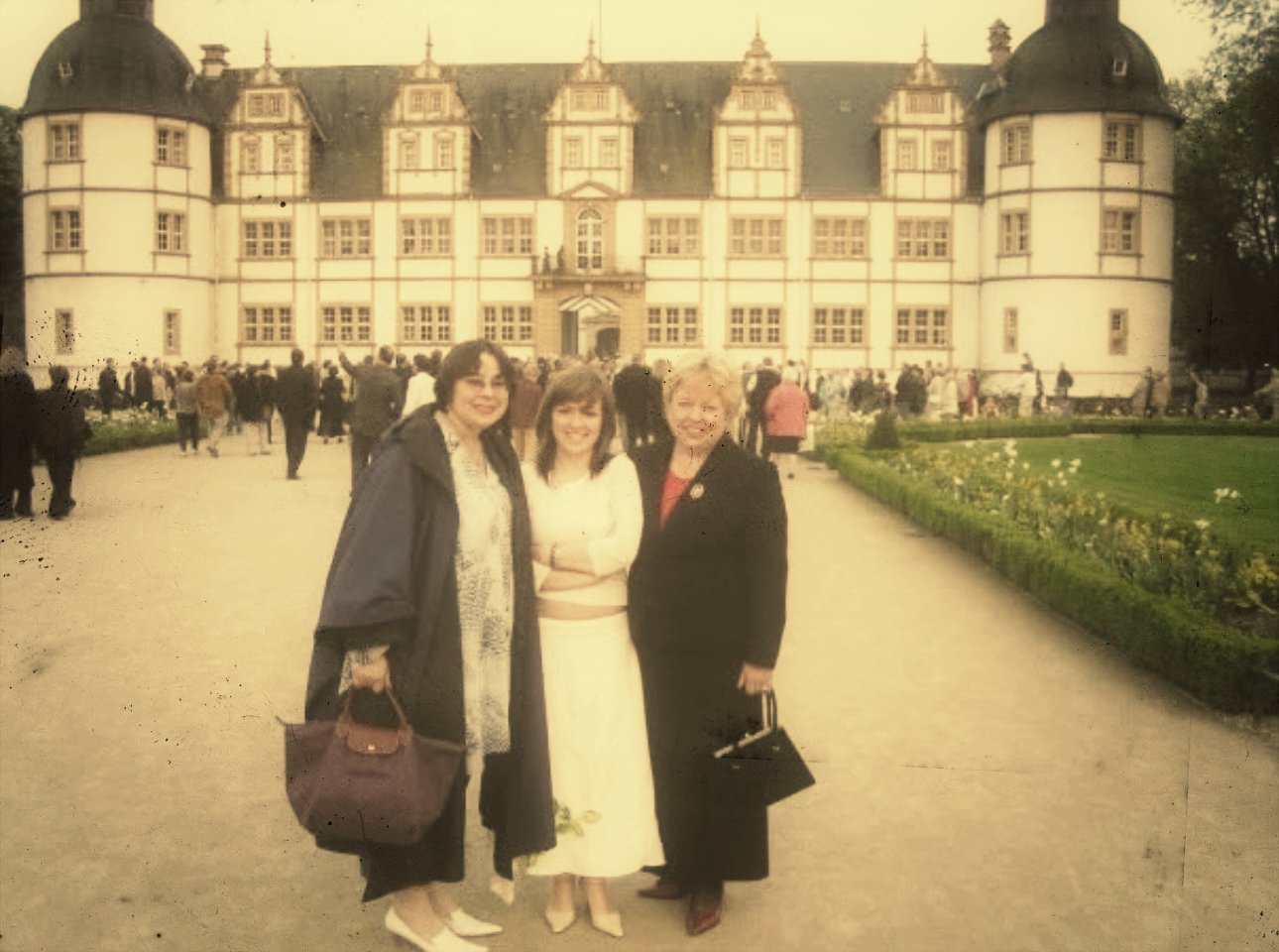
this photo shows a very early museum memory in early 2000s, when I worked at Schloß Neuhaus in Paderborn, Germany giving guided tours for the traveling Amber Room exhibition from St. Petersburg, Russia.