Why Art Matters. What Art Reminds Us When Words Fail - The Most Important Painting of My Life.

Michail Wrubel, Sitzender Dämon, 1890
Öl auf Leinwand, 114 × 211 cm
Staatliche Tretjakow-Galerie, Moskau
Foto: Alexander Rosanow**
“A first encounter with any new phenomenon exercises immediately an impression on the soul. This is the experience of the child discovering the world; every object is new to him.” - Wassily Kandinsky, Concerning the Spiritual in Art, 1912 *
This encounter taught me something fundamental: art carries human experience so deeply engraved that even a child can recognize it. And so enduring that it continues to unfold across an entire lifetime. Everyone who knows me knows this story. My mom and I can’t remember whether I was six, seven, or eight when we visited the Tretyakov Gallery in Moscow. I was used to museums. I was a very shy, well-behaved child, quiet, attentive. I had never thrown a tantrum in my life.
Until I encountered The Demon Seated by Mikhail Vrubel.
At first, my mother didn’t take my reaction seriously and wanted to move on. But I cried and begged to stay. I refused to leave. In the end, she had no choice, because I didn’t give her one. Until that moment, art had been part of my life: music lessons, ballet, drawing, museums. Art was something I did, not something I felt. But standing in front of this painting, something shifted. I cried. Not quietly. Not politely. I refused to leave. I remember sitting there, in front of that painting, for hours. Until the museum closed. To a little girl, the painting was larger than life. Yet the Demon did not appear monstrous. He was the most beautiful thing I had ever seen. Fragile, exhausted, trapped in a body too small for his longing. His gaze carried sorrow, restraint, and soft tenderness. I did not yet know the story, but I felt it in my body: this figure, painted almost a century before I was born, knew too much, felt too deeply, and belonged nowhere.
Little did I know that this painting would begin my lifelong dialogue with art.
The story follows a Demon, a fallen angel who has wandered the earth for centuries. The Demon and Tamara fell in love as deeply as it was forbidden, but his intense love killed her. In Lermontov’s poem, and even more so in Vrubel’s interpretation, the Demon is not a figure of moral evil, but of inner fracture: isolated by his awareness, fragmented by the impossibility of belonging, hyper-conscious yet suspended between heaven and earth, incapable of innocence. Vrubel paints him gazing into eternity while turned inward, his eyes heavy with longing and deep human exhaustion. His strong hands are locked in an impossible gesture, unable to stop the slow unraveling of what he knows he cannot save.

Michail Wrubel, Sitzender Dämon, 1890
Öl auf Leinwand, 114 × 211 cm
Staatliche Tretjakow-Galerie, Moskau
Foto: Alexander Rosanow**
To me, the Demon was never threatening. The flowers, the vibrant sky, the warmth of the horizon left me with an instinctive understanding of transformation, not collapse. I did not see a monster. I saw a figure of existential rupture, not an evil villain, but a consciousness exiled from innocence, suspended between longing and loss. This painting is a tragedy held in ambivalence. It is not caused by a single moral failure and cannot be resolved by choosing a side. It arises when opposing truths coexist: each valid, each destructive in its own way.
This is where borders dissolve: when stories begin.
Lermontov’s Demon is tragic because he is both capable of love and structurally incapable of sustaining it. He longs for redemption, yet his nature makes innocence impossible. His touch corrupts what he loves. His consciousness is too vast for the human world. Tamara’s death is not a punishment, nor a moral lesson. It is the tragic consequence of ambivalence: love as salvation and love as destruction. Vrubel captures this ambivalence into form. The Demon is powerful yet restrained, monumental yet compressed, alert yet exhausted, present yet unreachable. Nothing about him resolves. He is not acting. He is enduring. Vrubel’s Demon does not threaten the world. He withstands himself. This is tragedy without spectacle: no climax, no fall. Only suspension.
And yet, this is not where my story ends.
What art teaches, and what life eventually confirms, is that even the most ambivalent tragedies can be transformed. Not always into happy endings, but into deeper presence. Into a love that no longer destroys, but endures and presents itself differently. The Demon’s story ends in exile. Ours does not have to. Unlike him, we are not condemned to remain suspended forever. Where love once had no ground, something else can grow: clarity, dignity, and the quiet strength to remain. Is this the difference between myth and life? That we are allowed to continue? This is why art matters to me, and why it matters to those who live with it: because it is not first understood through intellect, but through the body. Through instinctual sensations, emotion, and recognition. This encounter taught me that art is not something we merely look at, but something that quietly reshapes how we feel, endure, and remain.
*Wassily Kandinsky, Concerning the Spiritual in Art, p.43
**Alle Abbildungen dienen der kunsthistorischen Einordnung und wurden aus dem genannten Katalog abfotografiert. Bildquelle: Michail Wrubel, der russische Symbolist, hg. von Jürgen Harten und Christoph Vitali, DuMont 1997.
Foto: Alexander Rosanow / Staatliche Tretjakow-Galerie, Moskau.
A later German essay returns to Vrubel’s Demon through Clarice Lispector, freedom, exhaustion, and the body of the image.
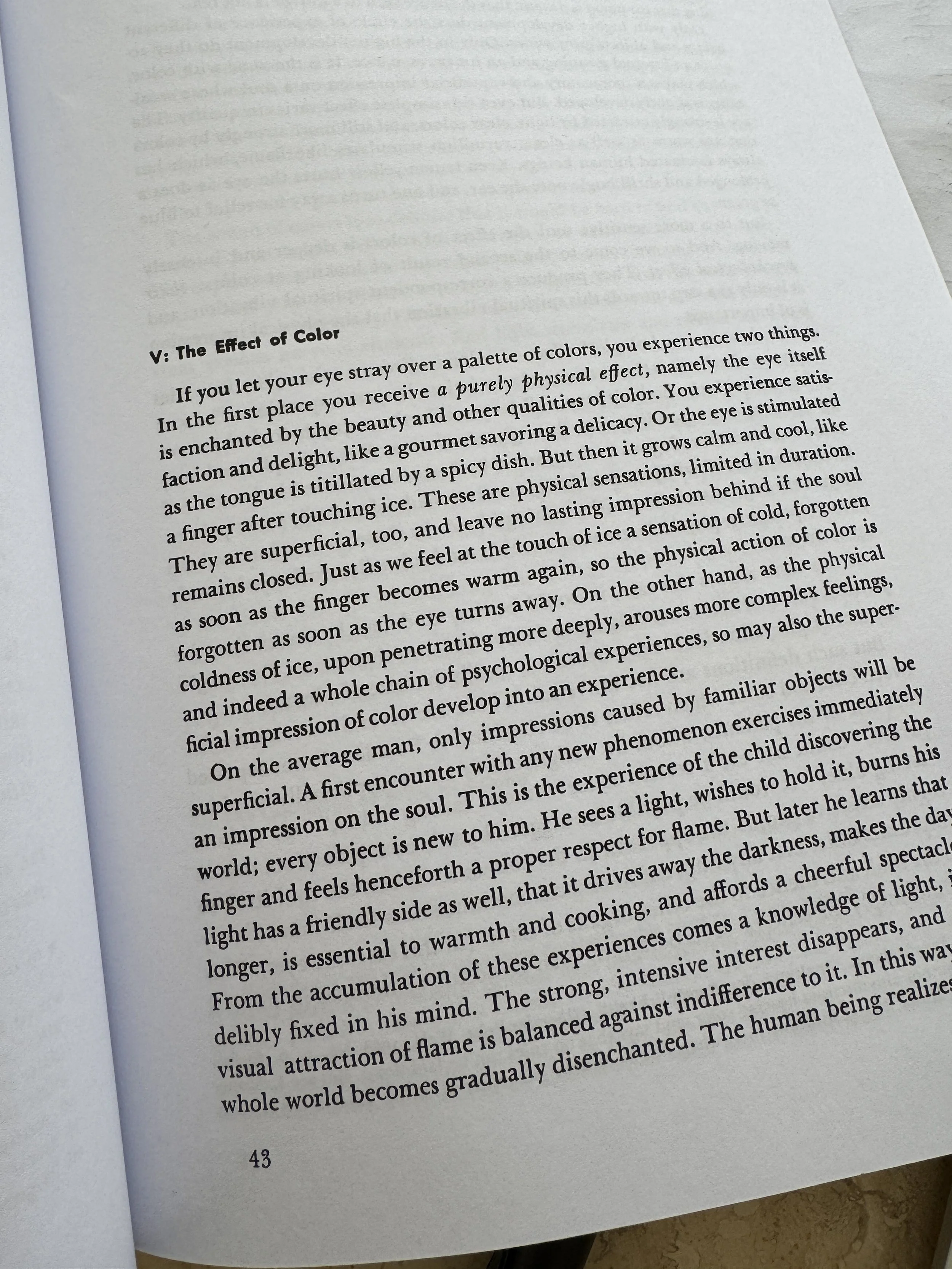
Wassily Kandinsky, Concerning the Spiritual in Art, p.43

Michail Wrubel, Sitzender Dämon, 1890
Öl auf Leinwand, 114 × 211 cm
Staatliche Tretjakow-Galerie, Moskau
Foto: Alexander Rosanow**

Michail Wrubel, Sitzender Dämon, 1890
Öl auf Leinwand, 114 × 211 cm
Staatliche Tretjakow-Galerie, Moskau
Foto: Alexander Rosanow**