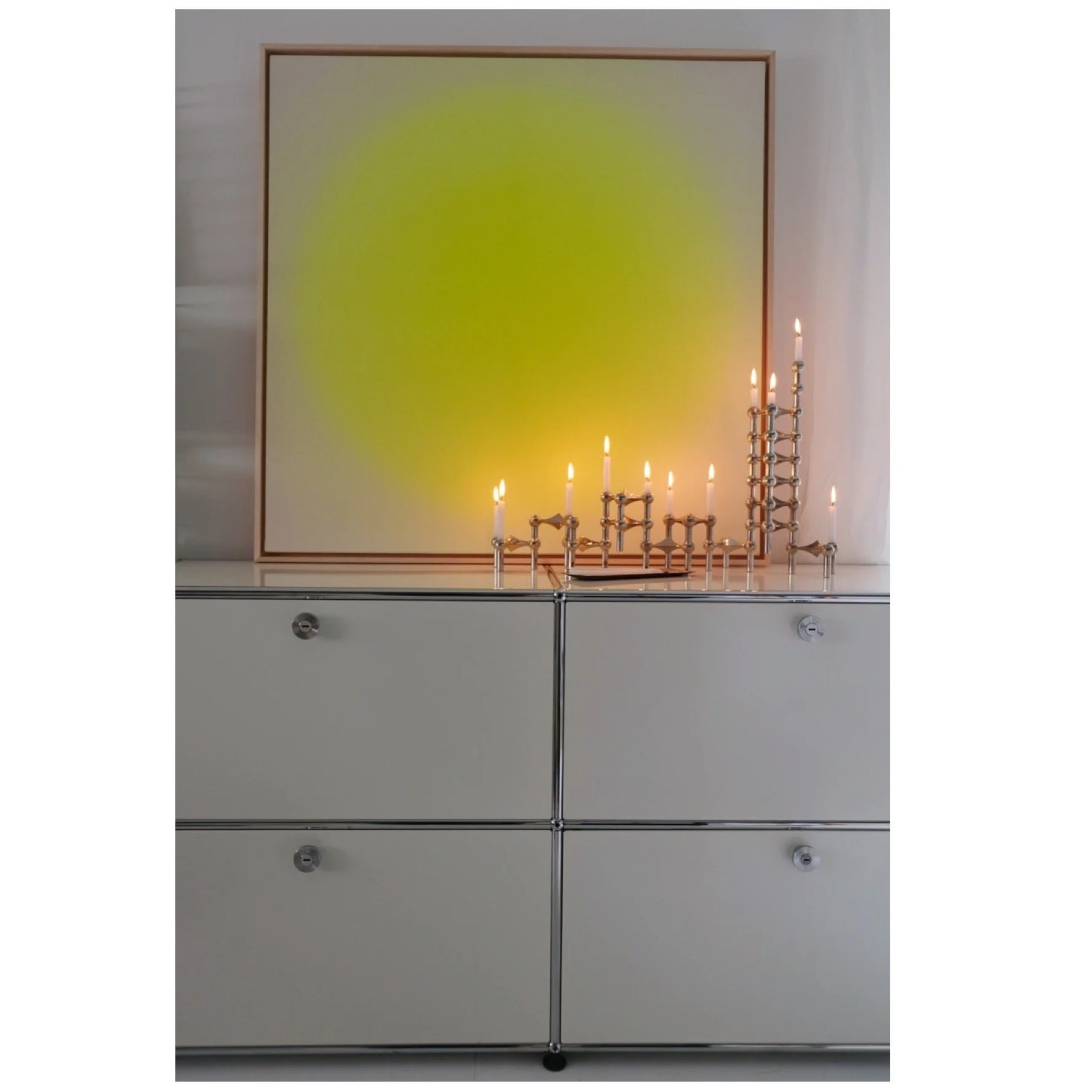
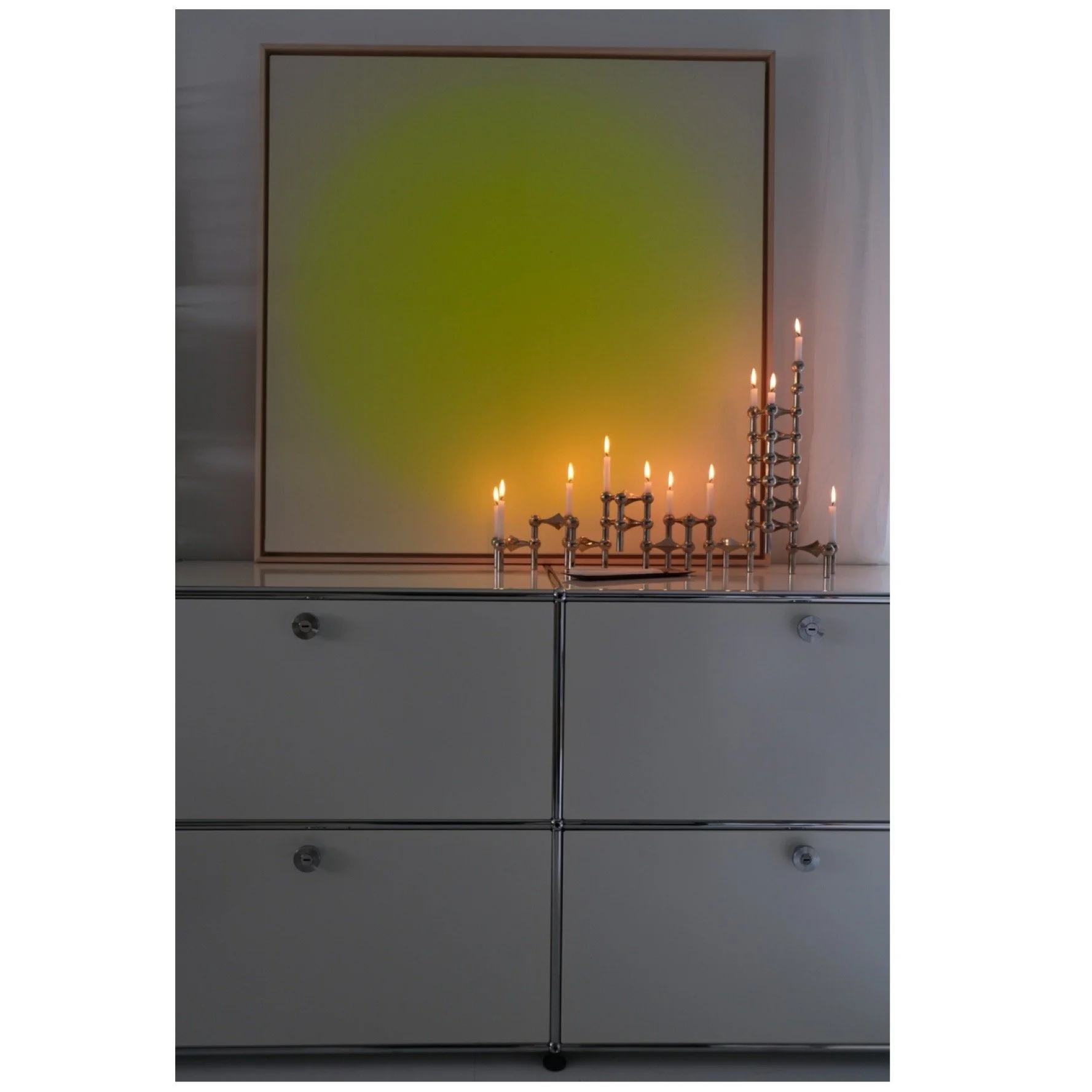
The glow of neon colors is a fascinating interplay between light, the material being used, and human perception. It is not a static state, but a process, an event bound to very specific conditions. Many so-called neon colors do not create their effect through pigment color alone, but through fluorescence. They absorb short-wavelength components of ambient light, often in the violet-blue range, and re-emit them as visible light, which makes the color appear more luminous. The color therefore appears "active" only as long as the necessary excitation conditions are met. In this sense, neon is less a color value than an event.

The Uniqueness of Neon Yellow
Fluorescent neon yellow holds a particular position within this field. Not because it is weaker than other neon colors, but because it responds differently to changes.
The Play with Warm Light
Warm-white light sources, as they are often used in living spaces, frequently contain lower proportions of short-wavelength light. As a result, the added luminosity of fluorescent pigments is reduced. The effect is not a complete disappearance, but a reduction in the intensity with which the color distinguishes itself from the surrounding light. Because yellow tones already fall within the longer-wavelength range of the visible spectrum, they have less room under warm light to assert a clear contrast. Other fluorescent colors may be perceived more strongly under the same conditions, depending, of course, on the interplay between light source, pigment, and environment.
The Canvas as an Active Partner
The beige canvas of the Sorbets, onto which the neon colors are applied in delicate gradient transitions, is not a neutral background. It reflects warmth, absorbs and diffuses light, and has no clear white point. In this constellation, color is not simply carried by the surface. It is actively shaped within the process of perception.
Something essential occurs especially with transparent layers, soft transitions, and non-opaque application: the canvas draws the yellow optically into itself. Not as extinction or erasure, but as assimilation. The yellow becomes part of the field, rather than a disruption within it.
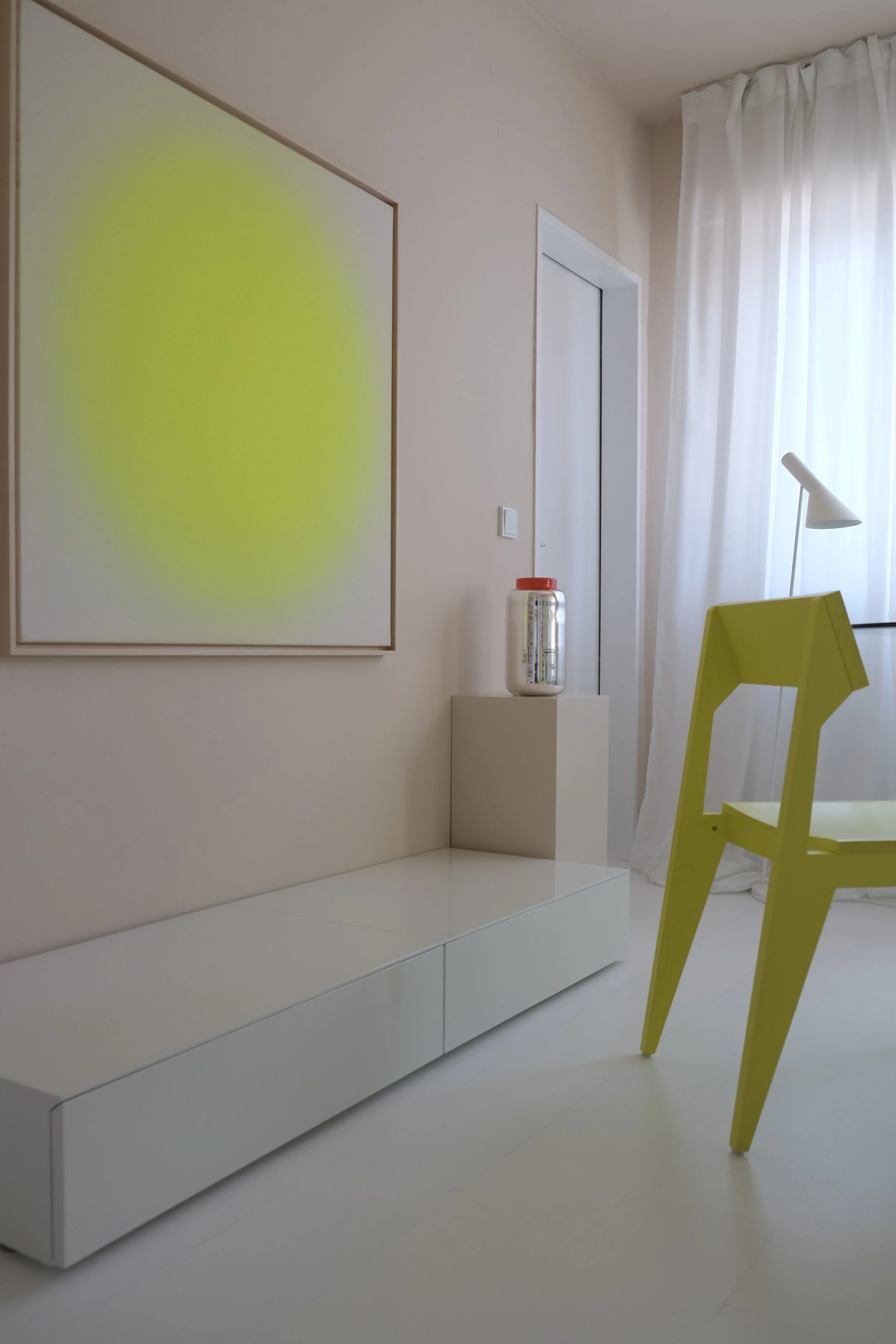
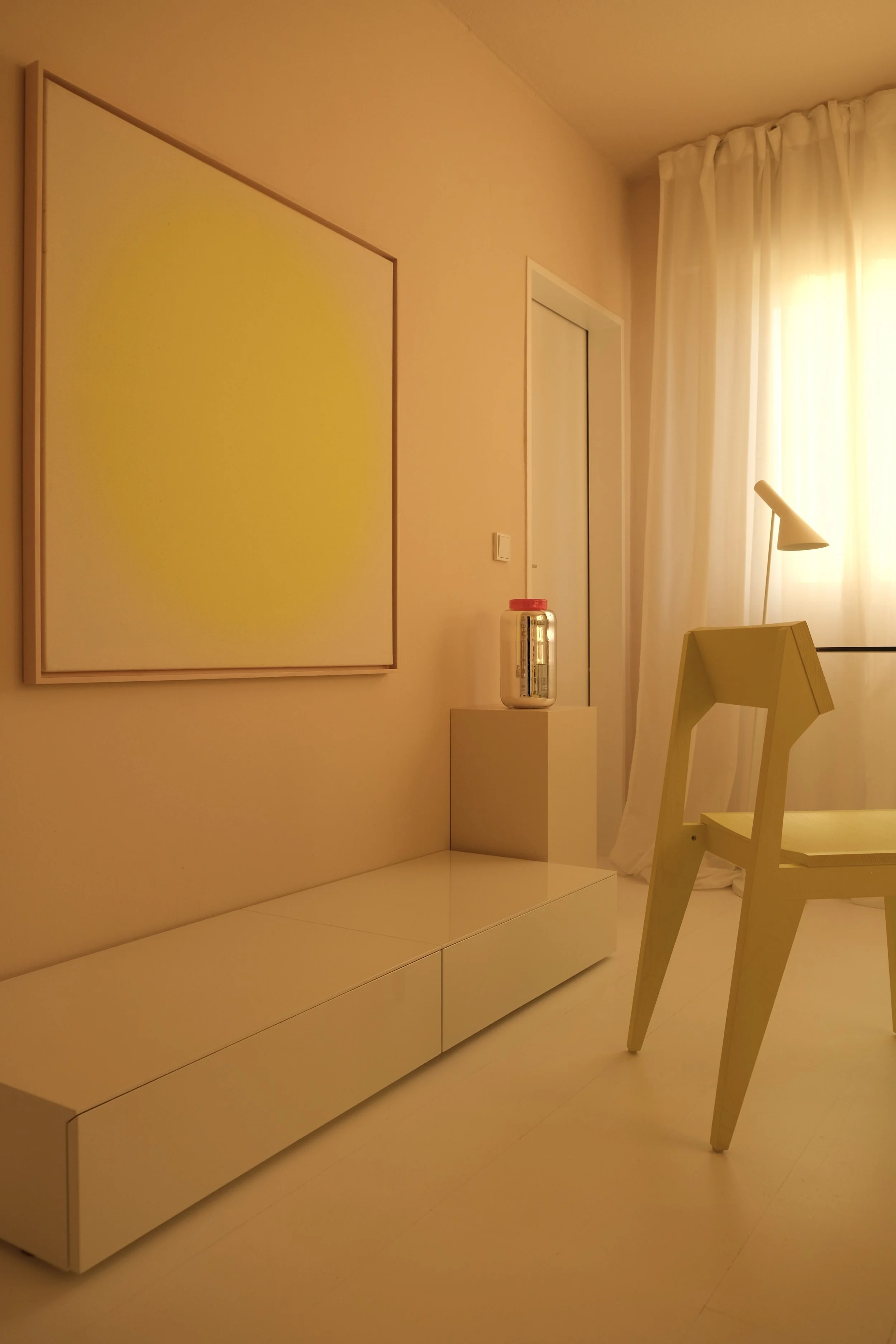
Dusk and the Quiet Withdrawal
The brightness of the surrounding environment also plays a role. As illumination decreases, the visual weighting of the eye begins to shift. Perception gradually moves into a range in which brightness counts more strongly than hue, and in which shorter wavelengths contribute relatively more to perceived luminance than longer ones. Yellow areas can therefore lose visual prominence in relative terms.
They do not become darker. They become quieter.
Under certain conditions — low color and brightness contrasts, warm illumination, and diffuse transitions — the visual separation between pigment application and canvas can begin to soften. The color is then perceived less as an independent event and more as part of the surrounding field. It remains present, but recedes in relation to the overall image.
The Particular Quality of Yellow Neon: a Philosophy of Attention
Fluorescent neon yellow appears here not as a signal, but as a sensitive indicator. It responds to light, time of day, and space. It oscillates between presence and withdrawal. The yellow remains present, but not independent. It does not demand attention, it allows attention only under certain conditions.
This is precisely where its autonomy lies: it is not a promise of permanent visibility, but a time-bound event.
In a world of permanent visibility, this is extraordinary. This yellow does not shout. It remains. And in doing so, it quietly shifts the question of what visibility means at all. And in doing so, it quietly proposes another definition of visibility: not as something that asserts itself under all conditions, but as something that unfolds through attention and time.